Musician Profiles:
Andy Fritz and Paul Austin
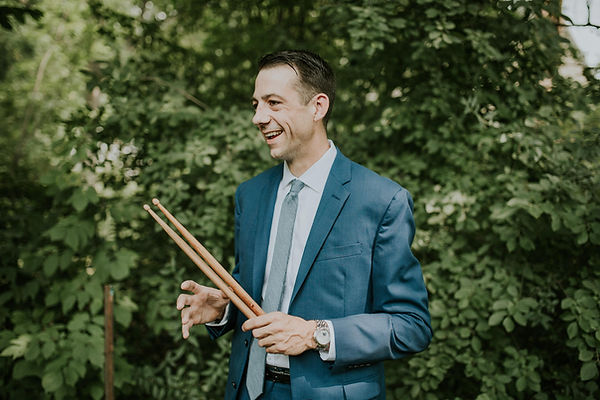
GRSMA percussionist Andy Fritz

GRSMA horn player Paul Austin
Stationed in the back of the orchestra as part of their GRS positions, percussionist Andy Fritz and horn player Paul Austin have a cinematic view of their colleagues. GRSMA highlights these two musicians in this feature.
GRSMA: Where did you grow up, and were you part of a musical family?
ANDY FRITZ: I grew up in Grand Rapids, so my first experience of live symphonic music was the Grand Rapids Symphony (GRS). My dad casually played a little piano and guitar, but no one in my immediate family is a professional musician. We listened to a lot of music in my home growing up: “West Side Story,” Lionel Ritchie, Genesis, Michael Jackson’s “Thriller,” “Les Miserables,” and some Andrew Lloyd Weber. When I decided to pursue music in college, I started taking private lessons with Bill Vits, former GRS Principal Percussionist. At the same time, I connected with my great-uncle Robert Bergt, who was a conductor in St. Louis with the ‘Bach Kantori,’ a chamber orchestra and chorus that specialized in performing the music of J. S. Bach and other baroque composers. He ultimately connected me with Webster University, where I completed my undergraduate studies in music.
PAUL AUSTIN: My dad was in the Air Force, so we were stationed all around the country. By the time I was in the third grade, I had been enrolled in four different elementary schools in three different states. When he retired from the service, our family moved to rural Tennessee, where he had grown up. My mother is German, so my childhood was similar to the television show “Green Acres.” I didn’t come from a musical family, but my mom recalls attending orchestra concerts at Frankfurt’s Opera House when she was a child. When I was very young, I remember making it a point to be in front of the television at 6pm to hear the theme music to the evening news (which I later discovered was the opening of the second movement of Beethoven’s Ninth Symphony) and being fascinated by the sound of an orchestra.
GRSMA: Tell us about your musical studies. Where did you receive your training to win an audition for the GRS?
PA: Actually, I started as a percussionist and switched to the horn in 8th grade. Realizing that I had a lot of catching up to do, I secretly used my lunch money to pay for private lessons. By 10th grade, I had earned a seat in All-State and was bitten by the orchestra bug when we played Shostakovich’s Fifth Symphony. My undergraduate degree is from Tennessee Tech University, which had a young faculty fresh out of Indiana University who played alongside us in the school’s orchestra. Our Sunday concerts were supplemented by string players from the Nashville Symphony Orchestra, so I was exposed to working with professional players. Aaron Copland had a week-long residency at TTU my sophomore year, which was impactful. My masters and doctoral degrees in performance are from the University of Cincinnati College-Conservatory of Music, which prepared me for orchestral auditioning. Being a Resident Artist at the Banff Centre for the Arts and studying with the renowned teacher Frøydis Ree Wekre was the final puzzle piece towards getting my GRS job.
AF: I completed my undergraduate in St Louis and then moved to Kansas City for a Masters degree at the University of Missouri Conservatory. I finished my formal orchestral studies at Roosevelt University in Chicago. I was very fortunate during those years to study and play with members of the St. Louis Symphony, Kansas City Symphony, and Chicago Symphony orchestras. There are experiences and insights gained from all of my teachers that I still use today. Prior to becoming a member of the GRS, I was a member of the Lansing Symphony, Battle Creek Symphony, and Ann Arbor Symphony. My work with those groups also influenced my orchestra playing and experience prior to joining the GRS.
GRSMA: Who are among your musical mentors and heroes?
AF: Bill Vits had a major influence on me. During the many years I was playing as an extra, whether it was the advice he would offer, observing how he would solve certain problems, or how he would play with the ensemble, there are constantly things in my playing I can attribute to his influence. I was also highly influenced by my teachers Ed Harrison and Vadim Karpinos of the Chicago Lyric Opera and Chicago Symphony, respectively. Their mastery and teaching style had a major impact on my approach to sound production, technique and style as well as strategies for learning complex music and staying afloat when things get crazy.
My musical heroes in the percussion world are Gary Burton, Joe Morello, Carter Beauford, Billy Martin, and Zakir Hussain. It was in college that I first learned of the collaboration between Gary Burton and Chick Corea; “Crystal Silence” and “Duets” were a constant in my musical rotation. Another influential album for me is Pat Methany and Charlie Hayden’s album “Beyond the Missouri Sky.” I am also a huge fan of our local community radio station WYCE 88.1. It’s a great resource, and I am constantly hearing new music and learning new artists.
PA: You might be surprised to hear that singers such as Jessye Norman and Dietrich Fischer-Dieskau have had an impact upon my musicianship and horn playing. Whenever I hear their recordings (Strauss “Four Last Songs,” for example, or Mahler lieder), their voices go right through me. I have deep admiration for many horn players and am concerned about leaving someone off a list here, but they know who they are.
GRSMA: Who are your favorite composers?
AF: There are so many, including Bela Bartok, Igor Stravinsky, Leonard Bernstein, Sergei Rachmaninoff, J. S. Bach, Steve Reich, Darius Milhaud, Claude Debussy, Maurice Ravel, George Gershwin, Frank Zappa, TRESOR, Sun-el Musician, Garth Stevenson.
PA: My favorite composers are Haydn, Schubert, Brahms, Hindemith, and Prokofiev.
GRSMA: If you weren't a musician, what other career path would you have taken?
PA: Good question! Maybe a writer or an actor? I think that I belong in the arts in some way if I couldn’t be a musician.
AF: I love music because it incorporates so many different disciplines. It is not only a physical and mental endeavor, it also involves history, theory, creativity, live performance, and recording. It is an art form but it’s also a craft and a skill. It can be an individual pursuit (soloing) and a collective pursuit (with the orchestra). We play music that is brand new, and we can perform masterpieces that are hundreds of years old. I can’t think of anything quite like it. It’s hard for me to imagine another path than the one I’m on. In reality I do have another calling, my wife and I run a sound healing, massage and bodywork business called Limitless Movement, so there’s that. Come check us out!
GRSMA: What are your hobbies or interests?
AF: I’m interested in a lot of different things. I enjoy process and learning about how things work. I’m an avid reader, when I have the time, and I enjoy riding and learning how to fix bikes. I’ve been interested in athletics, from running triathlons to sailing to anything outdoors. I’ve recently gotten into vegan cooking. I also try to lean into my role as a dad and love spending time with my two kids.
PA: I’ve embraced the puzzles that the New York Times offers and don’t try to do anything in the morning until after I’ve played Spelling Bee, the Mini Crossword, and Wordle. Later in the day, I play Letter Boxed and Tiles. Also, our ten-year-old golden doodle Autumn keeps me grounded.

I enjoy international travel and look forward to going to Poland this summer for the first time, in my role as Advertising Agent with the International Horn Society.
GRSMA: What would you say is the most rewarding part of being in the Grand Rapids Symphony?
PA: So many things come to mind. Having wonderful colleagues, representing our city, performing master works of classical music, playing a variety of genres (opera, pops, ballet). But the most rewarding? Being on the team. I’m that kid who was picked last in sports, and to be a team player means a great deal to me.
AF: Music is a strange phenomenon. When people come together to enjoy live music, it’s such a fleeting and ephemeral experience yet it can be so powerful. Often the most impactful experiences for me are those that I don’t anticipate; for example, when I’m surprised by a new piece of music, or when a familiar piece somehow meets the moment in an emotional or spiritual way. Being able to participate directly in those kinds of special moments, for myself, with colleagues, and with the audience is the most rewarding part of being with the GRS.
GRSMA: Is there a past GRS concert that you will always remember fondly?
AF: The moments that stick with me the most are occasions when my daughter has seen me play with the orchestra. We performed a Disney Program, Peter Pan ballet, and The Nutcracker which she attended at 3-4 years old, and she still talks about them. For her to think playing in an orchestra is just “normal” life for a Dad is pretty wonderful, and part of the joy in playing for me now is forming this foundation of early classical music exposure for both of my children.

PA: As odd as it sounds, it was the GRS concert immediately after our 2005 trip to Carnegie Hall. We did a side-by-side concert at an area high school, and my private horn student played the horn solo to the finale of Stravinsky’s “Firebird.” Of course, performing at the renowned concert hall in New York City was memorable, but my fond memory was the following week.
GRSMA: The 2025-26 GRS season is underway. https://www.grsymphony.org/2025-26-season
Is there an upcoming concert that you especially look forward to performing?
AF: A lot of great stuff is coming up, including Copland’s Third Symphony and “The Pines of Rome.” I’m especially looking forward to performing "Daphnis and Chloe” by Ravel. I’ve played it before, but never with a full chorus, and there is a ton of percussion in the dramatic and exhilarating finale. https://www.grsymphony.org/seductive-ravel
PA: One of my first years in the GRS, our third horn player became ill on the morning of rehearsals for Mahler’s Sixth Symphony. As utility horn, I had to move over and sight read the part. At that time, I was that guy who wanted to be ultra prepared for everything. But life isn’t always that way. In this case, I had no time to obsess about that demanding horn part. I just played it, and it went well. I look forward to performing Mahler’s Sixth again in March (this time the fourth horn part, however). I will be sure to take cover during the massive hammer blow from Andy’s section. https://www.grsymphony.org/mahlers-sixth
GRSMA: If you could go back in time and meet a musician, who would it be and why?
AF: Honestly, I might go really far back to Ancient Egypt or Ancient Greece. We have no real way of knowing what ancient music sounded like and can only speculate based on the artifacts we have; fragments of instruments or pictographs and writings about the music. It would be fascinating to find out what music in ancient societies sounded like.
PA: I know very little about my German family, and I am told that I had a great aunt who was a pianist. She was Jewish and survived the war, so I would like to meet her a few years after the war ended. No doubt music played a significant role in her life. I would say very little and listen very intently to Tante Paula.
GRSMA: Is there anything else that you wish to share?
PA: When I won my GRS horn position in 1999, the person I replaced was born on the exact same day as me. Yes, Jill Sipe and I were born just a few hours apart on May 25th, 19xx. I believe that should be somewhere on a list of amazing facts. Has that ever happened before in the world of professional orchestras? In all seriousness, though, I consider myself fortunate to share the stage with such talented and dedicated musicians, many of whom I consider to be my friends.
AF: The Grand Rapids Symphony is a non-profit organization which needs the support of donors and audience members in the community. It’s your support which makes our work possible. Every member of this orchestra has worked incredibly hard and made huge sacrifices to win an audition with this group and we are always striving to perform at a world class level. Whether you like pop music, classical, jazz, or heavy metal, there are so many different kinds of music and they all have their merits. When it comes to the arts I find it’s best to keep an open mind to something you’ve never experienced before and you might be surprised when something connects with you.
Also, come and say hello. We are members of the community, we live here, we work here, and raise our families here. We want to better know you (our audience) and be known by you. Don’t hesitate to come say “Hi,” ask questions, or share your experiences. It enriches our connection and purpose.